
Criminal Defense Attorney in Tulum
Most people who call us from Tulum never expected to need a Mexican lawyer. They are travelers stopped after a night out, buyers whose condo was never delivered, or residents served with a summons in Spanish. This page explains, in plain English, how a criminal case actually works in Tulum and what to do in the first hours.
Who handles your case: Tulum court, Playa del Carmen prosecutors, Cancún federal judges
Tulum has had its own judicial district since 2018. State criminal cases are heard by the control judge and the oral trial court of the Quintana Roo Judiciary located in Tulum (Avenida 1 at Agua Dulce, Tumben-Kaa neighborhood), under the Quintana Roo Penal Code and Mexico’s National Code of Criminal Procedure.
State investigations are run by the Central District Prosecutor’s Office (Fiscalía de Distrito Centro) of the Quintana Roo Attorney General, headquartered in Playa del Carmen. Federal offenses (firearms and ammunition, drug importation, smuggling) are prosecuted by Mexico’s Federal Attorney General (FGR) before the Federal Criminal Justice Center in Cancún, so a federal arrest in Tulum usually means hearings in Cancún.
The first 48 hours after an arrest in Tulum
- 48 hours: the prosecutor must bring you before a judge or release you (Article 16 of the Mexican Constitution).
- Initial hearing: the judge reviews whether the arrest was lawful. An illegal arrest can end the detention right there.
- 72 hours (extendable to 144): the judge decides whether to bind you over for trial (vinculación a proceso) and what pretrial measures apply.
- Interpreter and consulate: you have the right to an interpreter (Article 45) and to have your consulate notified (Article 151 of the National Code of Criminal Procedure).
Do not sign statements you do not understand, and do not agree to “fix it” with an informal payment. Anything you say before your lawyer arrives can be used later.
THC gummies and vape cartridges: legal at home, a crime in Mexico
Mexican law only treats tiny amounts as personal use. For marijuana the limit is 5 grams under Article 479 of the General Health Law. THC edibles and THC vape cartridges get no special treatment, and bringing them across the border can be charged as federal drug importation even when the quantity is small. In these cases the key question is often how the arrest happened, as the case below shows.
Real case in Tulum: unlawful arrest over marijuana gummies, released at the first hearing
In September 2026, a U.S. tourist traveling from Michigan arrived in Tulum by plane. He had already left the airport when the authorities reported that he was carrying some marijuana gummies. He was arrested a day later at his hotel and charged with narcotics importation.
We demonstrated that the arrest was unlawful. He was not caught in the act (flagrancia), because the pursuit was not uninterrupted: he was already at his hotel and was not arrested until the following day. The judge agreed with us, and he was released at the first hearing, the initial hearing (audiencia inicial), the equivalent of a first appearance in the U.S.
Every case is different. To protect confidentiality, we omit the details that would identify the client.
Useful guides: arrests at Mexican airports; Mexican drug laws; Mexican gun laws; criminal defense attorney in Cancún.
Firearms or ammunition in your luggage
A few forgotten rounds in a bag or a rental car can open a federal case. Since the reform published on May 29, 2025, Article 84 Bis of Mexico’s Federal Firearms and Explosives Law sets 6 to 12 years in prison for bringing in non-military firearms or cartridges without a permit, and Article 84 sets 7 to 30 years for those reserved to the armed forces. A U.S. gun license or permit is not valid in Mexico.
Real estate deals that turn into criminal complaints
Pre-sale condos, lots of ejido origin and informal rental agreements are common in Tulum, and so are fraud and dispossession (despojo) complaints. We represent foreign buyers who were defrauded and people accused by a buyer or partner. Before filing anything, we review the contract, the payment trail and the property’s chain of title. A complaint that is really a civil breach of contract tends to stall at the prosecutor’s office.
Tulum FAQ for visitors and foreign residents
Can I leave Mexico while my case is open?
Only if the judge allows it. A ban on leaving the country is one of the possible pretrial measures. Your lawyer can argue for alternatives such as a bond or periodic check-ins, but the decision is the judge’s.
Will the U.S. consulate get me out?
No. Consular officers can visit you, contact your family and check on your treatment, but they cannot act as your lawyer or appear for you in court.
I was held by immigration (INM), is that a criminal case?
Not by itself. An immigration hold is an administrative procedure, but it can lead to deportation. When the hold is unlawful, a federal amparo can challenge it.
Do you handle cases in Playa del Carmen and Cancún too?
Yes. We handle state and federal cases throughout Quintana Roo and the rest of Mexico.
The firm is led by attorney Germán Terríquez Córdova, with 15 years of experience in criminal defense. We work in English and Spanish.
Rulings in favor of our firm
These are rulings from our firm whose English-language documents have already been reviewed and do not expose unredacted client personal data. The full list is on Successful Cases.
Written and reviewed by Germán Jalil Terríquez Córdova, Esq. — Founder and Managing Director of Justicia Transparente. Mexican criminal defense attorney with 15 years of experience. Professional license (cédula profesional) No. 6691677 issued by Mexico’s Ministry of Education (SEP).
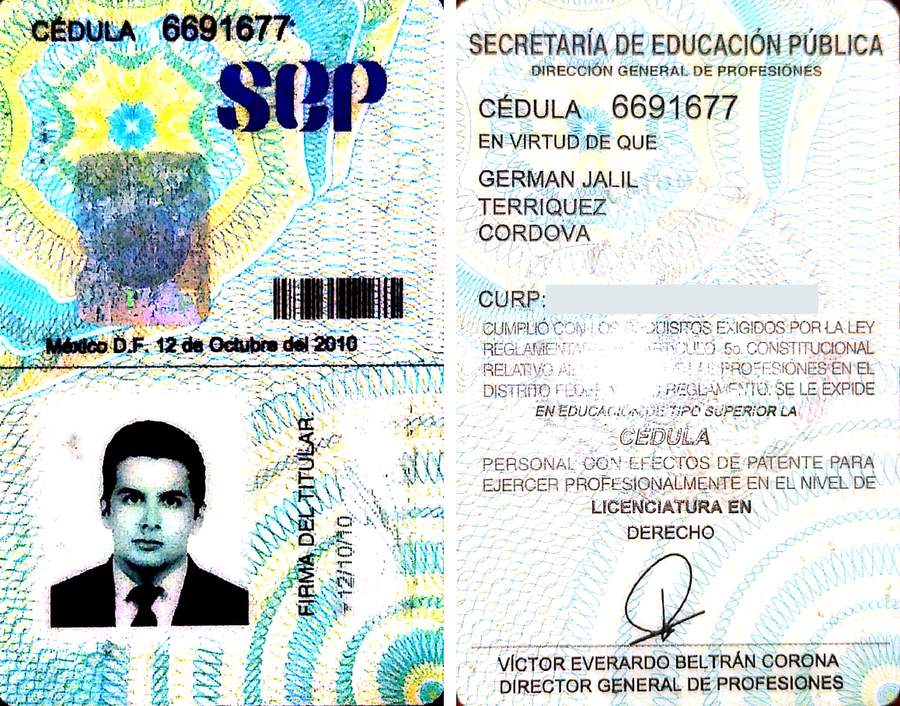
Check the attorney’s license here