
Mexican Smuggling Laws? Every day, thousands of Americans drive across the U.S.–Mexico border or board flights to Mexico without realizing that Mexican customs laws are very different from those in the United States.
Many travelers believe that carrying large amounts of cash or valuables is simply a customs issue that results in paying a fine. Unfortunately, that assumption can lead to an unexpected arrest.
Our criminal defense team has represented numerous American citizens detained after entering Mexico through border crossings and international airports. In many of these cases, the travelers had no criminal intent—they simply misunderstood Mexican law.
One of the most common mistakes involves entering Mexico with undeclared cash, negotiable instruments, or valuables exceeding the legal threshold established by Mexican law.
Accused a relative of a crime in Mexico? Do you need to know if it is a crime to bring weapons into Mexico? Do you need to know if it is a crime to bring marijuana into Mexico? The prosecutor is accusing me of having committed a crime that I did not commit? Has your loved one been in jail in Mexico for years?
If you are in one of these situations, hire an online consultation.
Do you want to avoid an arrest warrant against you in Mexico?
If you are planning to travel to Mexico, these are the three most important rules you need to understand to avoid a criminal investigation and possible detention.
Legal Basis for This Offense
Visit our online store
One of our products can help you
The following is the legal basis under Mexican law that criminalizes the failure to declare large amounts of currency or negotiable monetary instruments when entering or leaving Mexico.
Article 105, Final Paragraph – Federal Fiscal Code of Mexico (Código Fiscal de la Federación)
Any person who fails to declare to Mexican Customs, upon entering or leaving the country, that they are carrying cash, domestic or foreign checks, money orders, negotiable instruments, or any combination thereof, in an amount exceeding the equivalent of US $30,000, shall be subject to a prison sentence of three months to six years.
If a competent authority issues a final conviction for the commission of this offense, the amount exceeding the above-mentioned threshold shall become property of the Federal Treasury, unless the individual proves the lawful origin of those funds.
1.Bringing More Than $30,000 Into Mexico Without Declaring It Can Lead to Criminal Charges(Mexican Smuggling Laws
This is the most important rule every American traveler should know.
Mexican law establishes that any person who enters or leaves the country carrying cash, national or foreign checks, money orders, negotiable instruments, or a combination of these items exceeding the equivalent of $30,000 USD without declaring them to Mexican Customs may face criminal prosecution.
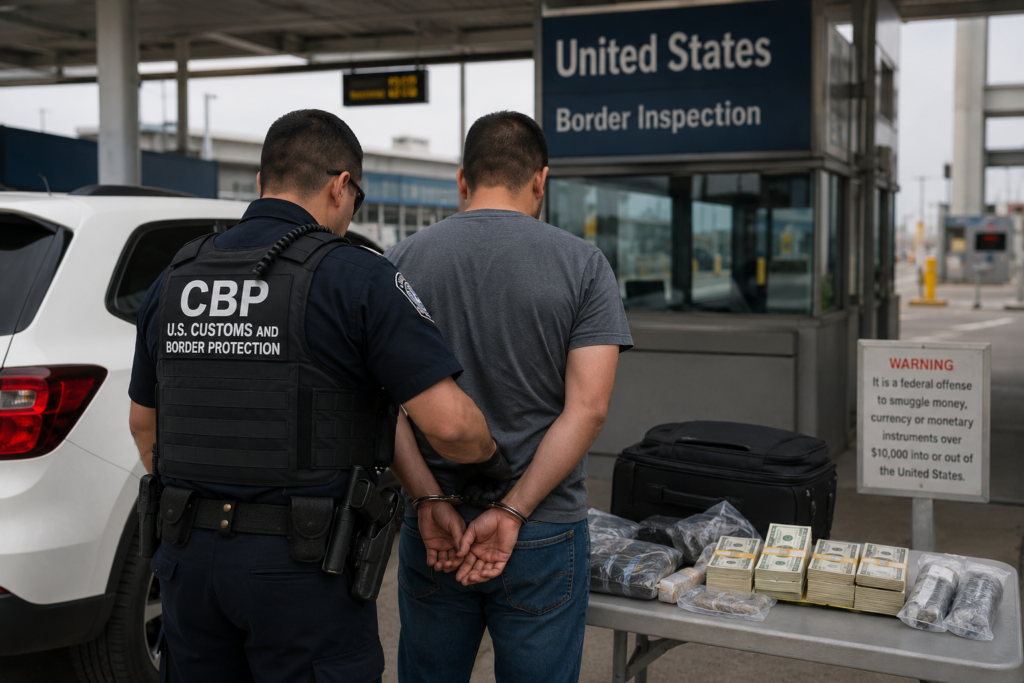
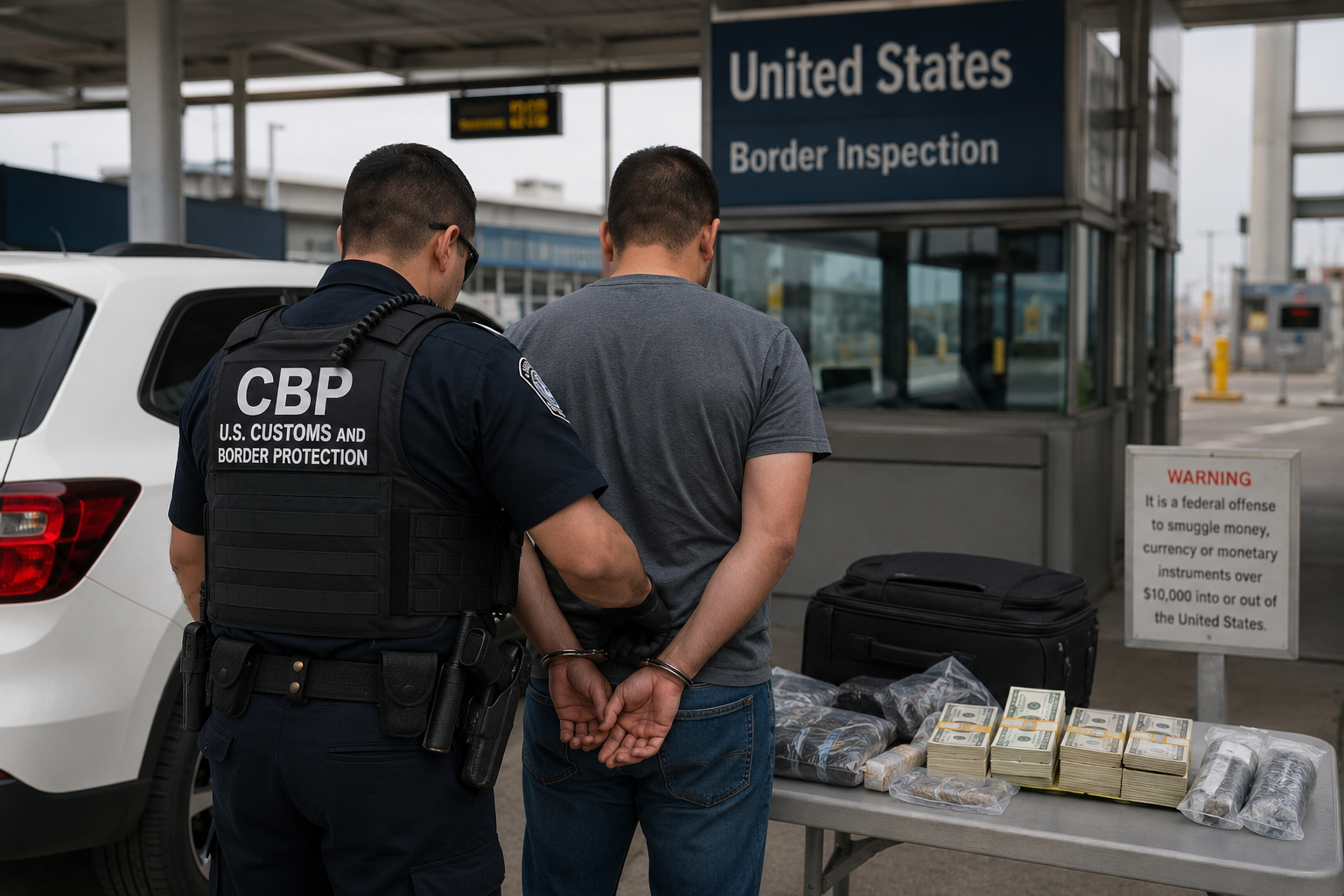
Many travelers become confused because they have seen signs at border crossings informing them that amounts of $10,000 USD or more must be declared.
Those signs are correct—but they do not tell the entire story.
The difference between $10,000 and $30,000 is critical.
If you carry more than $10,000 but less than $30,000, you may face an administrative customs violation that generally results in financial penalties.
However, once the undeclared amount exceeds $30,000 USD, the situation changes dramatically.
Instead of receiving only a customs fine, authorities may initiate a criminal investigation, and the traveler can be arrested and transferred to the Mexican Prosecutor’s Office (Fiscalía) for questioning.
This law applies not only to physical cash.
It can also include:
- Cash in any currency
- Domestic or foreign checks
- Cashier’s checks
- Money orders
- Negotiable financial instruments
- A combination of these assets
- In certain circumstances, valuables whose declared value exceeds the legal threshold
Many American travelers are surprised to discover that what they believed was simply a customs declaration issue has become a criminal case under Mexican law.
2. Smuggling Charges in Mexico Can Result in Pretrial Detention
Many Americans assume that if they are arrested in Mexico, they will simply post bail and return home while the case proceeds.
Unfortunately, that is not how many criminal cases operate under the Mexican legal system.
Mexico has significantly reformed its criminal justice laws during recent years.
Certain crimes—including customs-related offenses under specific circumstances—may expose defendants to much stricter detention rules than many Americans expect.
Unlike the United States, where posting bail is often available shortly after arrest, Mexican criminal proceedings follow a different constitutional framework.
For many customs-related prosecutions, the first objective of the defense is not simply requesting bail.
Instead, an experienced criminal defense attorney must evaluate every legal option available during the earliest stages of the case.
In many situations, the defense strategy focuses on negotiating a legal resolution that allows the defendant to avoid a lengthy criminal proceeding.
One of the most effective legal mechanisms available in appropriate cases is called the Conditional Suspension of Criminal Proceedings (Suspensión Condicional del Proceso).
This legal solution is somewhat comparable to certain forms of diversion or probation programs available in some U.S. jurisdictions.
If the legal requirements are satisfied, the criminal prosecution may be suspended while the defendant complies with court-ordered conditions.
Successfully obtaining this outcome often requires extensive negotiations with prosecutors, customs authorities, and the court.
For that reason, hiring a criminal defense lawyer experienced in Mexican customs cases can make a substantial difference.
Every case is unique, and the available legal strategies depend on the specific facts surrounding the arrest.
The First 48 Hours Are the Most Important Part of Your Defense
The first two days after an arrest are often the most critical stage of any criminal case in Mexico.
During approximately the first 48 hours, the American citizen is generally held while prosecutors determine whether sufficient evidence exists to formally present criminal charges.
During this period, investigators gather evidence, interview customs officers, review declarations, examine financial documentation, and prepare the criminal file.
After that initial investigation, the suspect is usually brought before a criminal judge in what is known as the Initial Hearing (Audiencia Inicial).
This hearing is somewhat similar to a first appearance or arraignment in the United States, although the legal procedures are different.
At this hearing, prosecutors formally explain the accusations and present the evidence supporting the arrest.
For the defense, this hearing is extremely important.
A qualified criminal defense attorney should immediately begin evaluating issues such as:
- Whether the detention was lawful
- Whether customs officers followed proper legal procedures
- Whether sufficient evidence supports the accusation
- Whether constitutional rights were respected
- Whether negotiated alternatives are available
- Whether diversion programs or conditional suspension may apply
Delaying legal representation can significantly reduce the defense’s available options.
For American citizens unfamiliar with the Mexican criminal justice system, immediate legal assistance is often essential.
Is This the Most Serious Crime Americans Face at the Mexican Border?
No.
From our experience defending American citizens, undeclared cash cases are generally less severe than other criminal investigations commonly seen at ports of entry.
Among the most common border-related criminal cases, they generally include:
- Firearm importation into Mexico
- Drug importation into Mexico
- Undeclared cash or financial instrument cases
Firearms cases frequently carry the most severe criminal penalties under Mexican federal law.
Drug importation offenses also involve serious legal consequences.
Cash declaration cases, while still criminal matters, often present more opportunities for negotiated legal resolutions when handled correctly from the beginning.
That does not mean they should be taken lightly.
Every customs investigation should be treated as a serious federal criminal matter requiring immediate legal representation.
What Should You Do If You Are Arrested at a Mexican Border Crossing or Airport?
If you or a family member is arrested after entering Mexico, you should:
- Remain calm.
- Do not make unnecessary statements without legal advice.
- Request to speak with an attorney immediately.
- Inform your family of your location.
- Contact the U.S. Consulate if necessary.
- Preserve any documentation showing the lawful origin of your money or valuables.
- Allow your attorney to begin building a defense before your first court hearing.
The sooner a criminal defense lawyer becomes involved, the more legal options may be available.
Crossing into Mexico with undeclared cash or valuables can quickly become far more serious than many American travelers expect.
Understanding the difference between administrative customs violations and criminal offenses may prevent unnecessary arrests and lengthy criminal proceedings.
Remember these three essential rules:
First, always understand Mexico’s declaration requirements before traveling.
Second, never assume that posting bail will immediately resolve a criminal case.
Third, obtain experienced criminal defense representation as soon as possible if you are detained.
Early legal intervention can often make the difference between prolonged detention and achieving the most favorable outcome permitted under Mexican law.
If you have been arrested at a Mexican border crossing or international airport, acting quickly is one of the most important decisions you can make. A defense strategy developed during the first 48 hours frequently has the greatest impact on the entire criminal case.
The Mexican criminal process explained in English

Facing Charges in México?.