

Marijuana laws in Baja California are mostly federal laws applied by state authorities. The rules on possession come from Mexico’s General Health Law (Ley General de Salud, LGS), which applies across the country, but most small-quantity cases in Tijuana, Mexicali or Ensenada are investigated by the Baja California state prosecutor and decided by state judges. Knowing which quantity falls into which category is the key to understanding any case. For a national overview, see Mexican drug laws; if someone has just been arrested, see arrested in Tijuana.
What counts as “possession”
The LGS defines possession broadly: it covers both physically holding a drug and having it “within the person’s range of action and availability” (article 473, section VI). That is why marijuana found in a car’s glove compartment, a backpack or a shared room can lead to a possession charge against the person who had control over that space. Who actually had access to the place where it was found is often a central defense issue.
The four quantity bands
The personal-use table in article 479 of the LGS sets 5 grams as the maximum amount of marijuana considered for strict and immediate personal consumption. From there, the law works in bands:
- Up to 5 grams, for personal use: the prosecutor does not bring criminal charges against a consumer or a person with drug dependence, as long as the possession is not in the places listed in article 475, section II (such as schools, or within 300 meters of them). The prosecutor must give the person information on treatment and prevention centers (article 478).
- More than 5 grams and less than 5 kilograms (1,000 times the table), no intent to sell: simple possession, punished with ten months to three years in prison and up to eighty days of fines (article 477).
- Same range, with intent to sell or supply, even for free: three to six years in prison (article 476). Selling or supplying in that range is punished with four to eight years (article 475).
- 5 kilograms or more: the case becomes federal, and the Federal Criminal Code presumes the possession is intended for trafficking-related conduct; the penalty is five to fifteen years in prison (Federal Criminal Code, article 195).
The difference between simple possession and possession to sell usually turns on circumstances: packaging, scales, cash, messages or the location of the arrest.
State court or federal court?
Under article 474 of the LGS, state authorities in Baja California handle the case when the drug is listed in the table, the quantity is below 1,000 times the table amount, and there is no indication of organized crime. Federal authorities take the case when the quantity is equal to or above that threshold, when organized crime is involved, when the substance is not in the table, or when the federal prosecutor takes over the investigation. This decides which prosecutor, which court and which detention center are involved.

Defense points we review in every possession case
- The weight. Whether the amount was weighed correctly, with or without packaging, and whether the expert report is reliable can move a case from one band to another.
- The chain of custody. The National Code of Criminal Procedure requires a documented record of how the evidence was found, packaged and transported (article 227).
- The legality of the search and arrest. If the arrest does not meet the legal definition of flagrancy, the prosecutor must order release (CNPP, article 149), and the judge reviews the arrest at the initial hearing.
- Who had control over the place where the drug was found.
- Alternatives to trial, such as a conditional suspension of the proceedings, which may be available for simple possession depending on the person’s history.
Legal help for your marijuana case in Baja California
If you or a relative were stopped with marijuana in Baja California, the first question is how much was seized and what the police report says about intent. That determines the charge and which court will hear it. Read also can you go to jail for marijuana in Mexico and drugs for personal use.
2026 Update: Legal Developments on This Topic
When we published this guide to Baja California marijuana laws in 2024, the key point was that drug laws in Mexico are federal, so Tijuana and the rest of the state follow the same rules as the whole country. That is still true in 2026. What follows is an update on what has and has not changed, with a focus on the situations that most often lead to arrests in Baja California: border crossings, traffic stops and possession above the personal-use limit.
Start with what has not changed. The personal-use table in Article 479 of the General Health Law still sets five grams of marijuana as the maximum amount that is not prosecuted. Possession above that amount, without a permit, can still be charged under Article 477 and related provisions. Congress has not passed a law regulating the recreational cannabis market, despite several proposals in recent years.
The 2021 Supreme Court decision that struck down the absolute prohibition is still the legal basis for adults to request a personal-use permit from Cofepris. That permit authorizes personal consumption and related activities in private; it does not authorize selling, carrying large amounts or crossing borders with cannabis. Anyone who has obtained such a permit should carry a copy and understand its limits.
The border is where most Baja California cases begin. In May 2026, the U.S. vice consul in Tijuana publicly warned travelers not to bring THC products, vapes, guns or ammunition into Mexico. Many visitors assume that a gummy or oil bought legally in California is harmless, but Mexican customs and prosecutors treat THC products under federal health law. Bringing cannabis from the United States into Mexico can be treated as an import offense, which is more serious than simple possession.
Vapes are now a separate problem. A reform to the General Health Law published on January 15, 2026 made it a crime to make, distribute or sell vaping devices, with prison terms between one and eight years plus fines ranging from 100 to 2,000 UMA. Cannabis vape cartridges therefore combine two risks: the device itself and its THC content.
Traffic stops and checkpoints are the second source of cases. Since 2025 Mexico’s National Guard is part of the Ministry of National Defense, and a national intelligence platform connects vehicle, phone and identity records. Officers can check plates and IDs faster than before. If you are stopped with cannabis, stay calm, do not consent to unclear searches without understanding them, and ask to speak with a lawyer.
Penalties depend on quantity and intent. Small amounts above the personal-use limit are usually charged as simple possession, while larger quantities or signs of sale, such as scales or many small packages, can lead to charges of possession with intent to sell. When synthetic drugs or fentanyl are involved, the case enters the list of crimes with automatic pretrial detention added to Article 19 of the Constitution in 2025, which changes everything for the person arrested.
Medical cannabis remains regulated separately. Patients who use cannabis-based products should use those approved or authorized by health authorities and keep their prescriptions and receipts. Importing medical cannabis for personal use without the right permits can still be a problem at the border.
Since September 1, 2025, federal judges in Baja California include those elected by popular vote, and the new Supreme Court is revisiting many criteria. Defense strategies that relied on older rulings must be checked against current practice in each courtroom.
For employers and landlords in Tijuana, it is worth remembering that a Cofepris permit protects the holder from criminal prosecution for personal use, but it does not override workplace rules or private contracts.
At Justicia Transparente we have 15 years of experience handling drug possession cases in Tijuana and across Baja California. If you or a relative were arrested for marijuana, we can review the file and explain your real options under the law in force in 2026.
Real case from our firm
This is a ruling from our firm whose English-language document has been reviewed in a public version and does not expose unredacted client personal data: American released in 3 days for marijuana possession. The full list is on Successful Cases.
The Mexican criminal process explained in English

Facing Charges in México?.


Known as “the Transparent Attorney,” he founded Justicia Transparente, turning it into a nationally recognized firm for its results and leadership. The author of four books, he has demonstrated that in this field, experience and strategy make the difference.
Written and reviewed by Germán Jalil Terríquez Córdova, Esq. — Founder and Managing Director of Justicia Transparente. Mexican criminal defense attorney with 15 years of experience. Professional license (cédula profesional) No. 6691677 issued by Mexico’s Ministry of Education (SEP).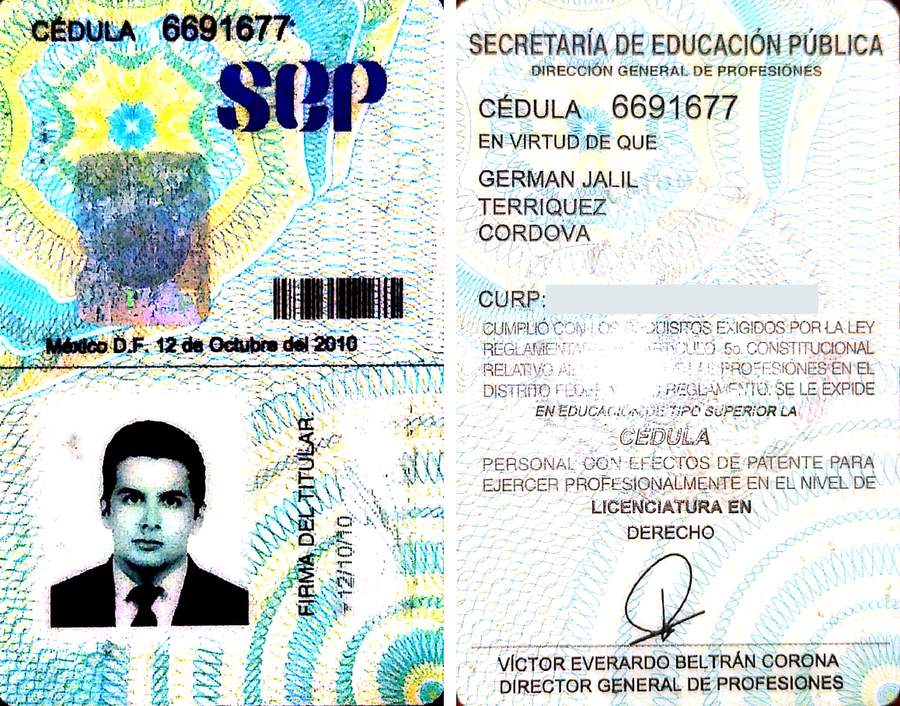
Check the attorney’s license here