

Quintana Roo Marijuana laws? The laws regarding marijuana in Mexico are federal; however, Quintana Roo (Cancun, playa del carmen and tulum) have a high rate of marijuana consumption, which makes it important to conduct a specific study on the case.
In Quintana Roo, the personal consumption of marijuana or cannabis is decriminalized, allowing a maximum possession of 5 grams (The law estabilish that). However, to possess larger quantities of marijuana or cannabis, it is necessary to have an order from a human rights judge that authorizes the possession of the desired amount, as it is a human right for the free development of personality.
However, possessing more than 5 grams without this human rights judge’s order could lead to prison sentences of at least 10 months and up to 25 years, as well as fines of up to approximately 3,000 dollars.
The crimes established by Mexican criminal law for marijuana-related offenses are as follows:
The concept of possession is established by Article 473, Section VI, of the General Health Law
“VI. Possession: the material possession of narcotics or when they are within the action range and availability of the person.”
Crime of Possession of Marijuana
Article 477. A sentence of ten months to three years in prison and up to eighty days of fines will be applied to those who possess any of the narcotics listed in the table in an amount less than that resulting from multiplying the amounts listed in that table by one thousand, without the authorization referred to in this Law, when, given the circumstances of the act, such possession cannot be considered intended for commercialization or distribution, even for free.
No criminal action will be pursued for this offense against those who possess medications containing any of the narcotics listed in the table, whose sale to the public is subject to special acquisition requirements, when, due to their nature and amount, such medications are necessary for the treatment of the person possessing them or other people under the custody or care of the person who has them in their possession.”
Article 478:
The Prosecutor will not exercise criminal action for the crime described in the previous article against those who are drug-dependent or consumers and possess any of the narcotics listed in the table, in an amount equal to or lower than that specified in the same table, for their strictly personal use, and outside of the places mentioned in Section II of Article 475 of this Law. The Ministry will inform the consumer about the location of institutions or centers for medical treatment or orientation for the prevention of drug dependence”.
Crimes Established in the Federal Criminal Code
“Article 195:
A sentence of five to fifteen years in prison and a fine of one hundred to three hundred and fifty days will be imposed on anyone possessing any of the narcotics mentioned in Article 193, without the corresponding authorization referred to in the General Health Law, as long as the possession is intended to carry out any of the actions specified in Article 194 of this code.
The possession of narcotics may be investigated, prosecuted, and, where appropriate, penalized by common jurisdiction authorities according to the terms of the General Health Law, when the conditions of Article 474 of this law are met.
When the accused possesses any of the narcotics listed in the table provided in Article 479 of the General Health Law, in an amount equal to or greater than the amount resulting from multiplying by one thousand the quantities mentioned there, it is presumed that the possession is intended to commit any of the actions described in Article 194 of this code.”
Table of Personal Drug Consumption in Mexico

Legal Help for Your Marijuana Case in Quintana Roo (Cancun, playa del carmen or tulum)
Mexican criminal laws are working to decriminalize the use of marijuana or cannabis; however, up to this point, it is still considered a serious crime affecting public health. At “Justicia Transparente,” we specialize in cases involving marijuana-related accusations.
February 2026: the Supreme Court on the five-gram limit
On February 4, 2026, the full Supreme Court (SCJN) decided amparo en revisión 132/2025, a case from Ciudad Juárez in which a person was charged with simple possession of more than five grams of cannabis. By a five-to-four vote, the Court granted the amparo against the part of Article 478 of the General Health Law that limits the personal-use exception to amounts “equal to or below” the table in Article 479. The ruling applies to that case only: it does not decriminalize cannabis, change the five-gram table or remove the crime of simple possession. Its importance is that authorities should not treat every amount above five grams as automatically criminal; they should assess whether possession was for personal use, considering quantity, time, place, manner and the person’s own circumstances. Because it is not a general rule, police and prosecutors in Quintana Roo may still apply the threshold first; the ruling becomes relevant in the defense.
2026 Update: Legal Developments on This Topic
Marijuana laws in Quintana Roo in 2026 are the same as in the rest of Mexico, because drug crimes and personal-use rules come from federal law. That point, which we explained in 2024, remains important for tourists in Cancún, Playa del Carmen and Tulum, where cannabis is often offered openly on the street. Seeing it sold does not make it legal.
Possession of up to five grams for personal use is tolerated under the General Health Law. Anything above that threshold lets prosecutors presume small-scale dealing, known locally as narcomenudeo. State prosecutors in Quintana Roo handle many small-quantity cases, while larger cases go to federal authorities.
Adults may apply for a permit from Cofepris for personal recreational use, based on the Supreme Court’s 2021 general declaration. That permit does not legalize buying, selling or public consumption. As of November 2026, Congress has not passed a law creating a legal cannabis market, so there are no licensed dispensaries in Quintana Roo or anywhere else in Mexico.
Public consumption is sanctioned administratively in many municipalities, and beaches, parks and areas near children are especially sensitive. Hotels may also prohibit smoking on their premises.
Vapes add a new risk. Since January 16, 2026, the General Health Law punishes the distribution and sale of vapes and e-cigarettes with one to eight years in prison. THC vape pens are doubly problematic, combining cannabis and vape rules.
Bringing cannabis from abroad is always illegal. Flying into Cancún with THC products bought legally in the United States or Canada can lead to arrest at the airport for importation, a federal crime.
Tourists are also targeted by scams. Some sellers work with fake police who then demand money. If anyone demands cash under threat, that may constitute extortion, punished since November 2025 under a general law with penalties of up to 42 years in aggravated cases. Report it and contact your consulate.
If you are detained, stay calm, ask for a lawyer, request that the substance be weighed in your presence and ask for consular notification. Do not sign documents you do not understand.
Synthetic drugs, including those laced with fentanyl, carry automatic pretrial detention since January 2025; never buy pills or powders from street sellers.
Travelers should know that the National Guard and state police conduct operations in tourist zones, especially during high season.
Another frequent problem in tourist areas is the purchase of so-called “legal” CBD or THC products in local shops. Some stores sell items labeled as hemp or wellness products, but their legal status in Mexico is uncertain, and products with THC can still lead to charges. Buying from a storefront does not guarantee protection if police inspect the item.
Cruise passengers face the same rules when they come ashore in Cozumel or Costa Maya.
Keep your passport and tourist card with you at all times.
Justicia Transparente has 15 years of experience and can coordinate defense for tourists detained in Quintana Roo. We do not promise outcomes; we explain the rules in force in 2026.
Real case from our firm
This is a ruling from our firm whose English-language document has been reviewed in a public version and does not expose unredacted client personal data: American released in 3 days for marijuana possession. The full list is on Successful Cases.
The Mexican criminal process explained in English

Facing Charges in México?.


Known as “the Transparent Attorney,” he founded Justicia Transparente, turning it into a nationally recognized firm for its results and leadership. The author of four books, he has demonstrated that in this field, experience and strategy make the difference.
Written and reviewed by Germán Jalil Terríquez Córdova, Esq. — Founder and Managing Director of Justicia Transparente. Mexican criminal defense attorney with 15 years of experience. Professional license (cédula profesional) No. 6691677 issued by Mexico’s Ministry of Education (SEP).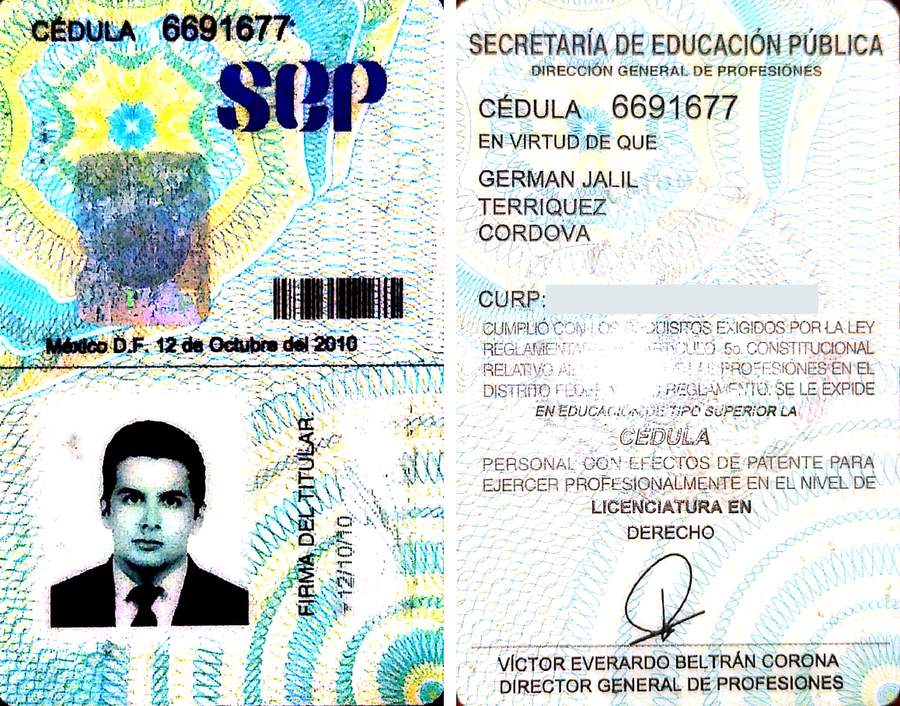
Check the attorney’s license here