
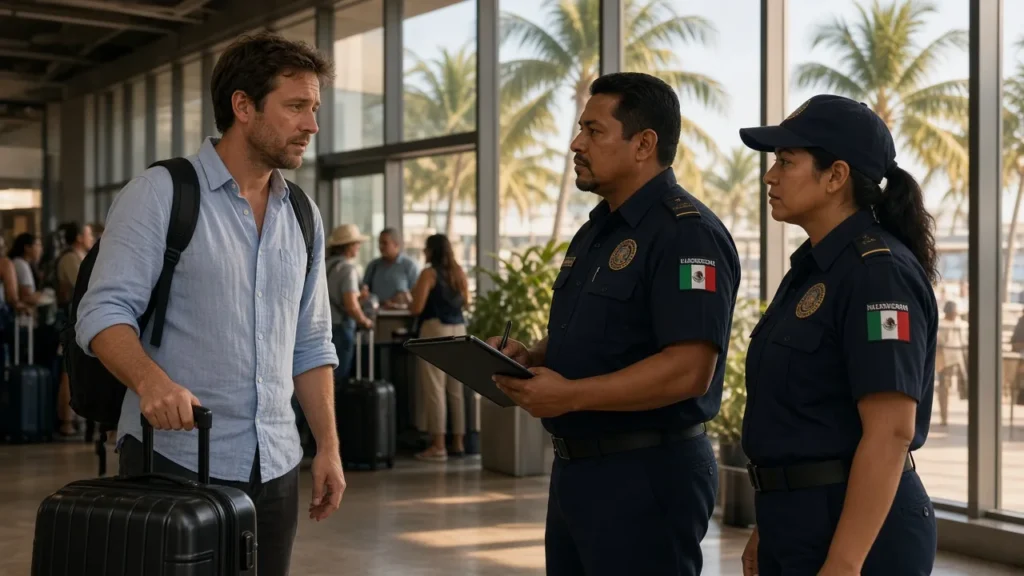
Every year millions of Americans fly into Mexican tourist cities such as Puerto Vallarta, Guadalajara, Monterrey, Mazatlán, Tulum, Cozumel, Mérida or San Miguel de Allende. Most trips end without problems, but a forgotten cartridge in a bag, a THC product, an undocumented prescription, an old arrest warrant or an incident during the stay can lead to a detention on arrival or departure.
At Justicia Transparente, Lic. Germán Jalil Terríquez Córdova and our team have 15 years of experience in Mexican criminal defense and assist U.S. citizens and their families. This guide gathers, in one place, what happens after an airport detention, how the Mexican criminal process works and the local details of ten tourist airports. It is general information, not a promise of any result: every case depends on its own facts and evidence.
If your case involves the airports we cover separately, see our guides for Los Cabos, Cancún, Tijuana and Mexico City, and the general overview of arrests at Mexican airports.
Table of contents
- Why Americans Are Detained When Arriving at a Mexican Airport
- What Happens After a Detention at a Mexican Airport: The Mexican Legal Process
- Airport-by-airport guide
- — Puerto Vallarta
- — Guadalajara
- — Monterrey
- — Mazatlán
- — Playa del Carmen
- — Tulum
- — Cozumel
- — Mérida
- — San Miguel de Allende
- — Ciudad Juárez
- What to Do If You or a Relative Is Arrested at a Mexican Airport
- Why U.S. Citizens Choose Justicia Transparente
- Frequently Asked Questions
- Contact
Why Americans Are Detained When Arriving at a Mexican Airport
a Mexican tourist destination has a legal detail many visitors miss: the bay is split between two states. The airport and the city are in Jalisco, while Nuevo Vallarta, Bucerías, Punta de Mita and Sayulita belong to Nayarit. A federal offense discovered at the airport (firearms or narcotics on an international flight) is handled by the federal prosecutor’s office (FGR), but an incident that starts at a rental in Nuevo Vallarta may be investigated by the Nayarit state prosecutor, with different offices, courts and timelines.
Do you want to avoid an arrest warrant against you in Mexico?
Typical the airport situations include a hunting rifle shell or a loaded magazine forgotten in a duffel bag, THC vape cartridges or gummies purchased legally in California or Arizona, prescription pills carried loose without the original label, and travelers who learn at the immigration desk that a Mexican court issued an arrest warrant years ago after a business or property dispute in the region.
Firearms and ammunition: a federal problem
Owning a gun legally in the United States does not authorize bringing it, its magazines or its ammunition into Mexico. When firearms or cartridges are found in luggage in a Mexican tourist destination, the case is usually investigated under the Federal Law on Firearms and Explosives, and some firearms offenses are among the crimes for which the Mexican Constitution (Article 19) provides mandatory pretrial detention. Saying the item was forgotten does not by itself stop a prosecution. Read more in our guide on whether you can bring a gun into Mexico.
Drugs, THC products and prescription medication
Mexico’s General Health Law sets very small personal-use thresholds, and bringing narcotics into the country on an international flight can be prosecuted as importation under the Federal Criminal Code, a far more serious charge than simple possession. THC gummies, vape cartridges and CBD products with THC can be treated as narcotics. Carry prescription medication in its original container with your prescription. See our overview of Mexico drug laws and criminal offenses.
Arrest warrants and accusations during the trip
Some travelers are detained at immigration in Jalisco because a Mexican judge issued an arrest warrant, sometimes years earlier. Others are accused during their stay of assault, theft, fraud or sexual offenses. In every scenario, the person has the right to remain silent, to a defense lawyer and to an interpreter.
What Happens After a Detention at a Mexican Airport: The Mexican Legal Process
- Inspection and retention. Customs, immigration (INM), the National Guard or police at Licenciado Gustavo Díaz Ordaz International Airport may retain the traveler and secure the evidence.
- Presentation to the Public Prosecutor (Ministerio Público). Under Article 16 of the Mexican Constitution, a person detained in the act must be brought before the prosecutor without delay. The prosecutor then has up to 48 hours (96 hours in organized-crime cases) to release the person or bring them before a judge.
- Consular notification. A foreign national has the right to have their consulate informed of the detention (National Code of Criminal Procedure, Article 151, and the Vienna Convention on Consular Relations).
- Initial hearing (audiencia inicial). A control judge reviews whether the detention was lawful, the prosecutor presents the accusation, and the judge decides on precautionary measures.
- Decision on vinculación a proceso. The judge has 72 hours, which the defense may ask to extend to 144 hours, to decide whether the case moves forward, giving the defense time to present evidence.
- Complementary investigation and resolution. Depending on the case, the law may allow alternatives such as conditional suspension of the process, restorative agreements in some offenses, an abbreviated procedure, or a trial.
Learn more about the first steps in our guide on arrests at Mexican airports and in Arrested in Mexico: your rights.
Video: Lic. Germán Jalil Terríquez Córdova explains what Americans detained in Mexico should do
In this video, Lic. Germán Jalil Terríquez Córdova, criminal defense attorney with 15 years of experience and founder of Justicia Transparente, explains in English a topic that frequently comes up when Americans are arrested at Mexican airports: Arrested at a Mexican Airport: What U.S. Travelers Should Do First.
Airport-by-airport guide
Detained at Puerto Vallarta Airport (PVR)
Puerto Vallarta is one of the favorite Pacific escapes for Americans. Direct flights arrive every day from Los Angeles, Phoenix, Dallas, Houston, Chicago, Denver, Seattle and many other U.S. cities, and the Bay of Banderas attracts retirees, wedding parties, fishing groups and families who rent condos in the Romantic Zone or resorts in Nuevo Vallarta.
Most arrivals at Licenciado Gustavo Díaz Ordaz International Airport (PVR) take less than an hour: immigration, baggage claim, the customs traffic light and a taxi to the hotel. But every season some travelers are pulled aside at the customs inspection area or at the immigration desk, and a vacation turns into a criminal investigation before they ever see the beach.
Common detention scenarios in Puerto Vallarta
Puerto Vallarta has a legal detail many visitors miss: the bay is split between two states. The airport and the city are in Jalisco, while Nuevo Vallarta, Bucerías, Punta de Mita and Sayulita belong to Nayarit. A federal offense discovered at the airport (firearms or narcotics on an international flight) is handled by the federal prosecutor’s office (FGR), but an incident that starts at a rental in Nuevo Vallarta may be investigated by the Nayarit state prosecutor, with different offices, courts and timelines.
Typical PVR situations include a hunting rifle shell or a loaded magazine forgotten in a duffel bag, THC vape cartridges or gummies purchased legally in California or Arizona, prescription pills carried loose without the original label, and travelers who learn at the immigration desk that a Mexican court issued an arrest warrant years ago after a business or property dispute in the region.
Who handles the case in Puerto Vallarta
Learn more about the first steps in our guide on arrests at Mexican airports and in Arrested in Mexico: your rights.
Is Nuevo Vallarta handled by the same prosecutors as Puerto Vallarta?
Not always. Puerto Vallarta is in Jalisco and Nuevo Vallarta is in Nayarit. Federal crimes detected at the airport go to the FGR, but state-level crimes are investigated by the prosecutor of the state where the events occurred.
Which consulate helps Americans detained at PVR?
The U.S. Consular Agency in Puerto Vallarta, under the U.S. Consulate General in Guadalajara, can provide consular assistance. It cannot represent you in court.
Detained at Guadalajara Airport (GDL)
Guadalajara is Mexico’s second-largest metropolitan area and one of the main gateways for Americans traveling to western Mexico. Its international airport, located in Tlajomulco de Zúñiga south of the city, receives business travelers, Mexican-American families visiting relatives, medical tourists, and thousands of U.S. retirees who live around Lake Chapala, Ajijic and Chapala.
Because so many passengers at Miguel Hidalgo y Costilla International Airport (GDL) are frequent travelers or residents, they often feel at home. That comfort sometimes leads to mistakes: a firearm left in a checked bag after a trip to Texas, medication carried for a relative, or an old legal problem in Jalisco that nobody thought would follow them to the airport.
Common detention scenarios in Guadalajara
GDL is a busy hub with connections from Los Angeles, San Francisco, Chicago, Dallas, Houston, Phoenix and many more U.S. cities. Customs inspections for international flights are carried out by Mexican customs authorities, and when they find firearms, ammunition or narcotics, the case goes to the federal prosecutor (FGR). Incidents that happen in the city or around Lake Chapala, such as traffic accidents with injuries, assault allegations or fraud complaints, are generally handled by the Jalisco State Prosecutor’s Office.
A pattern we see with Guadalajara-area residents is the arrest warrant that surfaces at immigration or during a return trip. A landlord complaint, an unpaid business deal, a domestic dispute or a property sale gone wrong can lead to a criminal complaint and, eventually, a judicial warrant. The person may not know a case exists until they are detained.
Who handles the case in Guadalajara
Learn more about the first steps in our guide on arrests at Mexican airports and in Arrested in Mexico: your rights.
I live near Lake Chapala. Can an old complaint lead to an arrest at GDL?
Yes. If a Jalisco judge issued an arrest warrant, authorities may execute it when you pass through the airport. Checking your legal status before traveling is a prudent step.
Which consulate helps Americans detained in Guadalajara?
The U.S. Consulate General in Guadalajara provides consular assistance to U.S. citizens detained in Jalisco and neighboring states.
Detained at Monterrey Airport (MTY)
Monterrey is Mexico’s industrial capital and a constant destination for American engineers, executives, plant managers, contractors and families with roots in Nuevo León. Many of them fly in from Houston, Dallas, San Antonio, Chicago or Detroit; others drive from Texas through Laredo and later fly home.
General Mariano Escobedo International Airport (MTY), located in Apodaca, handles a large flow of business travelers. These passengers rarely think of themselves as at risk of arrest, yet business travelers can be detained just like tourists, especially when a firearm, ammunition or a controlled substance appears in their luggage, or when a commercial dispute has escalated into a criminal complaint.
Common detention scenarios in Monterrey
Texas proximity creates a specific risk in Monterrey. Many travelers own firearms legally in Texas and keep a pistol, a magazine or loose rounds in a truck, a range bag or a suitcase. When that bag crosses into Mexico, whether at the land border or at MTY, Mexican law does not recognize the Texas permit. Firearms offenses are federal and are prosecuted by the FGR before federal judges.
Business disputes are the other Monterrey pattern. Allegations of fraud, breach of trust (abuso de confianza), unpaid invoices treated as fraud, or labor-related accusations can lead to criminal complaints before the Nuevo León State Prosecutor’s Office. If a judge issues an arrest warrant, an executive can be detained when arriving for a meeting.
Who handles the case in Monterrey
Learn more about the first steps in our guide on arrests at Mexican airports and in Arrested in Mexico: your rights.
Is an arrest at Monterrey airport a state or federal case?
It depends on the offense. Firearms, ammunition and drug importation cases are usually federal. Fraud, assault or traffic-injury cases are usually handled by the Nuevo León State Prosecutor.
Does my Texas concealed carry license help in Mexico?
No. U.S. firearm permits have no legal effect in Mexico, and bringing firearms or ammunition into the country without authorization can lead to federal charges.
Detained at Mazatlán Airport (MZT)
Mazatlán has grown into one of the most popular Pacific destinations for Americans and Canadians. Snowbirds spend the winter in the Golden Zone and Cerritos, sport-fishing groups arrive for marlin and dorado, and cruise ships call at the port. Many visitors fly into General Rafael Buelna International Airport (MZT) from Phoenix, Los Angeles, Dallas, Denver or Minneapolis.
Mazatlán is also in Sinaloa, a state where Mexican authorities are especially strict with firearms, ammunition and drugs. A traveler who would never think of themselves as a suspect can be detained after a routine inspection finds something they forgot was in their bag.
Common detention scenarios in Mazatlán
Fishing and hunting culture makes ammunition one of the most common problems at MZT. A few cartridges in a tackle box, a fishing vest or the pocket of a jacket can be enough for customs to retain a passenger and refer the case to the federal prosecutor. Mexican law treats unauthorized ammunition seriously, separate from firearms.
Drug enforcement is another priority in Sinaloa. Marijuana products, THC edibles, vape cartridges and prescription medications without proper documentation can trigger a federal investigation. Officers do not distinguish between a product that is legal in Arizona or Colorado and an illegal substance under Mexican law.
Who handles the case in Mazatlán
Learn more about the first steps in our guide on arrests at Mexican airports and in Arrested in Mexico: your rights.
Can a few rounds of ammunition really lead to arrest in Mazatlán?
Yes. Bringing ammunition into Mexico without authorization may be investigated as a federal offense even if no firearm is present.
Which consulate helps Americans detained in Mazatlán?
The U.S. Consular Agency in Mazatlán, under the U.S. Consulate General in Hermosillo, provides consular assistance.
Arrested After Arriving in Playa del Carmen (via Cancún or Tulum)
Playa del Carmen does not have its own international airport, but it is one of the most visited places in Mexico by Americans. Most visitors land at Cancún International Airport (CUN), about 45 to 60 minutes north, or at the newer Felipe Carrillo Puerto International Airport in Tulum (TQO), and then take a shuttle down Highway 307 to Quinta Avenida, Playacar or the resorts of the Riviera Maya.
That means a criminal problem for a Playa del Carmen visitor can start at the airport inspection, on the road, or days later in town. This guide focuses on what happens around arrival and the first days of a stay, without repeating our separate guide on detentions inside Cancún airport.
Common detention scenarios in Playa del Carmen
Typical Playa del Carmen cases include drugs bought in the street or at a beach club and found during a police stop, THC products brought from the U.S. and detected on arrival, altercations at bars on Fifth Avenue or Calle 12, accusations involving sexual offenses after a night out, and rental-car accidents with injuries on Highway 307.
Jurisdiction matters. Drugs or firearms found at CUN or TQO on an international arrival are usually federal matters for the FGR. Incidents in Playa del Carmen itself, such as assault, property damage, theft accusations or traffic injuries, are generally handled by the Quintana Roo State Prosecutor’s Office in the municipality of Solidaridad.
Who handles the case in Playa del Carmen
Learn more about the first steps in our guide on arrests at Mexican airports and in Arrested in Mexico: your rights.
If I land at Cancún but stay in Playa del Carmen, who handles my case?
Federal crimes detected at the airport go to the FGR. Crimes committed in Playa del Carmen usually go to the Quintana Roo State Prosecutor.
Can a bar fight in Playa del Carmen lead to jail?
It can lead to detention and a criminal investigation, especially if someone is injured. The legal outcome depends on the evidence and the classification of the offense.
Detained at Tulum Airport (TQO)
Detained at Tulum Airport? Tulum’s Felipe Carrillo Puerto International Airport (TQO) opened in December 2023 and quickly started receiving direct flights from major U.S. cities. For Americans heading to Tulum’s boutique hotels, wellness retreats, cenotes and festivals, the new airport means skipping the long drive from Cancún.
The airport is operated under military administration, and inspections on international arrivals are taken seriously. Travelers who bring THC products, microdosing supplies, psilocybin, or prescription medication without documentation can find themselves detained before reaching the jungle.
Common detention scenarios in Tulum
Tulum’s reputation for wellness and nightlife creates specific risks. Some visitors assume that cannabis, mushrooms or ceremonial substances are tolerated in Mexico. They are not: outside very limited exceptions, possession beyond personal-use thresholds and any importation of controlled substances can be prosecuted, and bringing them across the border is treated much more severely than simple possession.
Festival seasons add another layer. Detentions after police operations near clubs and parties, accusations of drug sales, and sexual-offense allegations involving tourists are handled by the Quintana Roo State Prosecutor if they occur in town, while anything found on an international arrival at TQO is usually a federal case for the FGR.
Who handles the case in Tulum
Learn more about the first steps in our guide on arrests at Mexican airports and in Arrested in Mexico: your rights.
Are THC gummies legal to bring to Tulum?
No. Bringing cannabis or THC products into Mexico on an international flight may be investigated as a federal drug offense, regardless of their legal status in the United States.
Which consulate helps Americans detained in Tulum?
The U.S. Consulate General in Mérida covers Quintana Roo, with support from the consular agency in Playa del Carmen.
Detained at Cozumel Airport (CZM)
Cozumel is one of the busiest cruise ports in the world and a favorite for American divers. Travelers reach the island in three ways: direct flights to Cozumel International Airport (CZM) from cities such as Houston, Dallas, Atlanta and Charlotte; the ferry from Playa del Carmen; or a cruise ship that docks for the day.
Each route has its own risks. Divers and long-stay visitors pass through airport customs; cruise passengers have only a few hours ashore and must return to the ship on time. When a cruise passenger is detained, the ship may sail without them, leaving the traveler alone on an island with a criminal investigation underway.
Common detention scenarios in Cozumel
At CZM, the common problems mirror other Mexican airports: ammunition or knives in dive bags, THC products, and prescription medications without documentation. On shore excursions, the typical cases are different: purchases of drugs from street sellers, fights at bars near the cruise piers, accusations of theft or damage, and incidents during excursions or scooter and jeep rentals.
Federal offenses found at the airport go to the FGR. Incidents on the island are generally investigated by the Quintana Roo State Prosecutor. Because Cozumel is an island, detainees may be transferred to the mainland, which makes it important for relatives to confirm quickly where the person is being held.
Who handles the case in Cozumel
Learn more about the first steps in our guide on arrests at Mexican airports and in Arrested in Mexico: your rights.
What happens if I am detained in Cozumel and my cruise ship leaves?
The cruise line may sail without you. You will need to resolve your legal situation in Mexico and then arrange travel home. A lawyer and the consulate can help coordinate.
Can I be transferred off the island after an arrest in Cozumel?
Depending on the offense and the authority involved, detainees can be transferred to mainland facilities. Relatives should ask exactly which authority and location holds the person.
Detained at Mérida Airport (MID)
Mérida has become one of the favorite cities for American expats in Mexico. Its colonial center, safety reputation and cost of living attract retirees, remote workers and investors who buy and restore old houses. Many of them fly through Manuel Crescencio Rejón International Airport (MID), often connecting via Houston, Dallas, Miami or Mexico City.
Because many Americans in Mérida are residents rather than tourists, their legal problems tend to be different: property and construction disputes, contractor complaints, family matters, or medications they bring back from the U.S. for chronic conditions.
Common detention scenarios in Mérida
For expats, a recurring risk is the criminal complaint that started as a civil disagreement. A dispute with a contractor, a seller or a former partner over a house renovation can turn into a fraud accusation before the Yucatán State Prosecutor. If a warrant is issued, it may be executed when the person returns through MID.
Medication is another point. Retirees often carry several months of prescriptions. Mexico controls many psychotropics and narcotics, and some ADHD and pain medications common in the U.S. are tightly restricted. Carrying medication in original containers with the prescription and a doctor’s letter reduces risk, but does not guarantee that an inspection will end without questions.
Who handles the case in Mérida
Learn more about the first steps in our guide on arrests at Mexican airports and in Arrested in Mexico: your rights.
Can a dispute over a house renovation in Mérida lead to arrest?
It can if the other party files a criminal complaint, such as fraud, and a judge issues a warrant. Many such disputes have civil remedies, but a criminal case must be addressed promptly.
Which consulate helps Americans detained in Mérida?
The U.S. Consulate General in Mérida, which covers the Yucatán Peninsula.
Detained at San Miguel de Allende Airport (BJX/QRO)
San Miguel de Allende Airport Arrests? San Miguel de Allende is home to one of the largest communities of American retirees in Mexico, and it is a top destination for weddings, art lovers and long-stay visitors. The town has no commercial airport. Most Americans fly into Del Bajío International Airport (BJX) near León and Silao, about 90 minutes away, or into Querétaro Intercontinental Airport (QRO), roughly an hour away.
These two airports are in different states: BJX is in Guanajuato and QRO is in Querétaro. That detail matters if an incident occurs during arrival, because state-level crimes are investigated by the prosecutor of the state where they happen, while firearms or drugs on an international flight are federal matters.
Common detention scenarios in San Miguel de Allende
Common situations for San Miguel residents and visitors include firearms or ammunition brought from home for ‘protection’ of a rural property, medication supplies for months, cannabis products, and accusations arising from real-estate deals, employment of household staff, or neighbor disputes that end up before the Guanajuato State Prosecutor.
The road between the airports and San Miguel is another source of cases: traffic accidents with injuries are criminal matters in Mexico when someone is hurt, and drivers can be detained at the scene until the Public Prosecutor evaluates the facts and the insurance coverage.
Who handles the case in San Miguel de Allende
Learn more about the first steps in our guide on arrests at Mexican airports and in Arrested in Mexico: your rights.
Which airport is closer to San Miguel de Allende for legal purposes?
Neither is ‘closer’ legally. BJX is in Guanajuato and QRO is in Querétaro. Federal crimes are handled by the FGR, while state crimes are handled by the state where the events occurred.
Is a car accident a crime in Mexico?
When there are injuries or deaths, a traffic accident can be investigated as a non-intentional criminal offense, and the driver may be detained while the Public Prosecutor reviews the case.
Detained at Ciudad Juárez Airport (CJS)
Detained at Ciudad Juárez Airport? Ciudad Juárez and El Paso form one of the largest binational metro areas in the world. Thousands of U.S. citizens cross every day to work in the maquiladoras, visit family, or catch domestic flights from Abraham González International Airport (CJS), which is often cheaper than flying within Mexico from El Paso.
Because many travelers cross by land and then fly from CJS, the airport security checkpoint is often the first serious inspection of their luggage in Mexico. Items that were never noticed at the bridge, such as a magazine in a backpack or a pill bottle without a label, can lead to a detention at the airport.
Common detention scenarios in Ciudad Juárez
Firearms are the dominant risk in Juárez. Texas and New Mexico travelers often own guns and ammunition, and Chihuahua authorities, together with federal agencies, are particularly alert to weapons trafficking. A single round of ammunition at the CJS security filter can lead to retention by authorities and a referral to the FGR.
Juárez also sees cases related to drugs detected at security checkpoints, warrants connected to family or business disputes in Chihuahua, and allegations involving maquiladora employment or vehicle imports. State crimes are investigated by the Chihuahua State Prosecutor (Fiscalía Zona Norte), while weapons and narcotics cases are generally federal.
Who handles the case in Ciudad Juárez
Learn more about the first steps in our guide on arrests at Mexican airports and in Arrested in Mexico: your rights.
Can I be arrested at Ciudad Juárez airport for ammunition even on a domestic flight?
Yes. The issue is the possession of firearms or ammunition in Mexico without authorization, not only importing them on an international flight.
Which consulate helps Americans detained in Ciudad Juárez?
The U.S. Consulate General in Ciudad Juárez provides consular assistance to U.S. citizens detained in the area.
What to Do If You or a Relative Is Arrested at a Mexican Airport
- Stay calm and do not resist or argue with officers.
- Do not sign documents you do not understand; ask for an interpreter.
- Use your right to remain silent until you speak with a defense lawyer.
- Ask that the U.S. consulate be notified.
- Relatives should write down the name of the authority, the location and the case number (carpeta de investigación).
- Be cautious with anyone offering to ‘fix’ the case for cash; ask for an attorney’s credentials and a written agreement.
- Contact an experienced Mexican criminal defense lawyer immediately.
Why U.S. Citizens Choose Justicia Transparente
Our firm focuses on criminal defense in Mexico, with 15 years of experience in the accusatory system. We communicate with families in English, explain each stage in plain language, and coordinate with relatives in the United States. We do not promise results; we offer a serious, honest legal analysis of each file. If you were detained in another destination, see our Los Cabos criminal defense lawyer guide, our Criminal attorney in a Mexican tourist destination page and our a Mexican tourist destination warrant check lawyer resource.
Frequently Asked Questions
Will the U.S. Consulate get me released in Mexico?
No. The consulate can visit you, contact your family and provide a list of lawyers, but it cannot dismiss charges or order your release. You need a Mexican defense attorney.
Is there bail in Mexico?
Mexico uses precautionary measures instead of U.S.-style bail. A judge may impose a financial guarantee, periodic check-ins or travel restrictions, or pretrial detention, depending on the offense and the risks argued.
Can I return to the United States while my case is open?
It depends on the precautionary measures ordered by the judge. Some measures prohibit leaving the country; others may allow it under conditions.
Contact a Criminal Defense Lawyer in Mexico Today
Call or message Lic. Germán Jalil Terríquez Córdova at +52 686 372 7664 (phone and WhatsApp). The earlier a defense lawyer reviews the case, the more options can be evaluated within the 48-hour window.
The Mexican criminal process explained in English

Facing Charges in México?.